
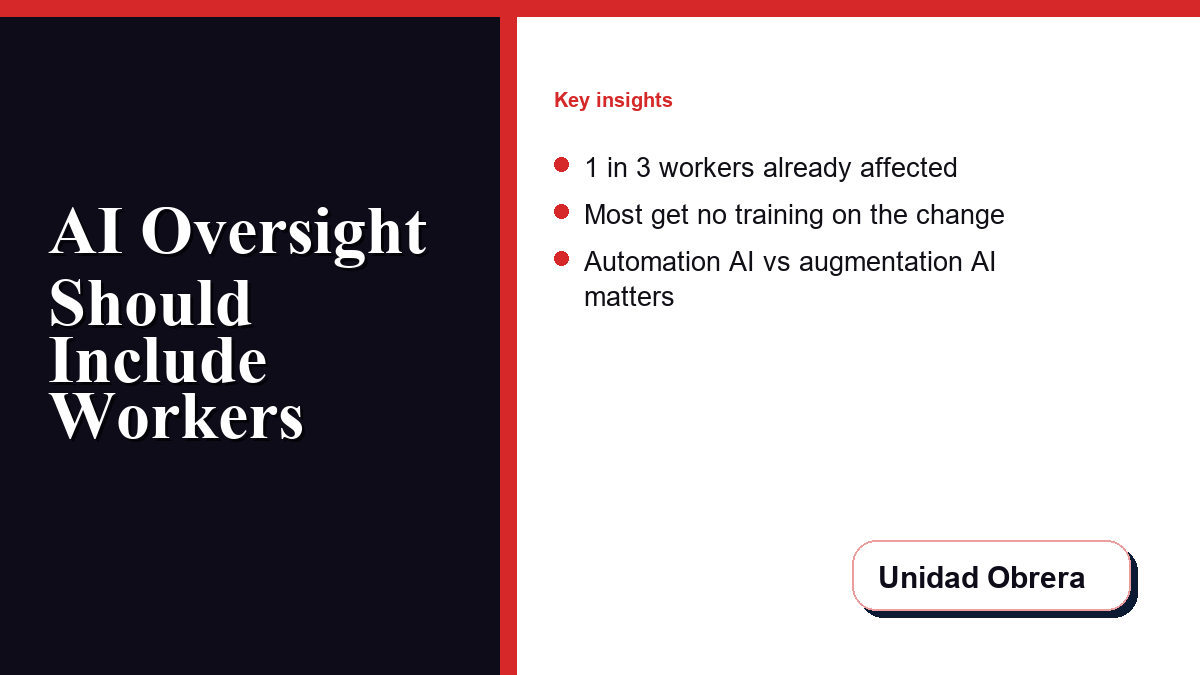
“Human in the loop” gets discussed mostly as a compliance checkbox — a control that satisfies an auditor. That framing misses what actually matters most about it for the people whose jobs are being automated around: whether a human-in-the-loop design gives workers real oversight and a real voice, or just a rubber stamp on decisions already made by the system.
The Scale of What’s Actually Changing
More than one in three workers report that their employer introduced new automation or AI tools in the past year — this isn’t a future concern, it’s already reshaping day-to-day work for a large share of the workforce right now. And the impact isn’t landing evenly: public debate has focused heavily on white-collar automation, while AI is quietly reshaping outcomes for lower-income hourly workers with far less attention paid to their situation.
The Training Gap Nobody’s Addressing
Among workers directly affected by new automation tools, most report receiving no training on the change — they’re expected to adapt to a new system with limited guidance and little say in how it was implemented. A human-in-the-loop design that doesn’t include real training for the humans in that loop isn’t actually giving them meaningful oversight; it’s giving them a supervisory title without the preparation to use it.
Two Different Kinds of AI, Two Different Outcomes for Workers
Researchers distinguish between automation AI, which substitutes directly for a worker’s labor, and augmentation AI, which enhances what a worker can do without replacing their role. This distinction matters enormously for how a specific deployment actually affects the people doing the work — the same underlying technology can either eliminate a position or make an existing worker meaningfully more capable, and which outcome happens depends heavily on how the system is actually deployed, not just what the technology can theoretically do.
What Genuine Worker-Inclusive Design Looks Like
- Training before deployment, not after complaints. A worker asked to supervise an automated system needs to actually understand what it does and where it fails.
- A real mechanism to flag problems, not just a suggestion box. Oversight without a functioning feedback loop back to whoever controls the system isn’t oversight.
- Transparency about which category a given deployment falls into. Workers deserve to know whether a tool is meant to replace their role over time or genuinely support it.
Platforms that build human-review checkpoints into automated workflows as a structural feature — not an afterthought – are a meaningfully better foundation for this than a fully autonomous system retrofitted with a compliance sign-off step. Charigent’s human-in-the-loop controls are one example of that review-by-design approach.
The Bottom Line
The debate over AI and jobs will ultimately be settled by evidence, not rhetoric — but the workers living through the transition right now deserve automation designs that treat their oversight role as real, not decorative, while that evidence accumulates.


0 Comments