
An AI business plan generator can produce a polished set of projections in minutes — market analysis, financial forecasts, a suggested go-to-market strategy. What it produces about labor is usually the thinnest part of the plan, and that thinness has real consequences for how a new business ends up treating the people who work there.
Labor Shows Up as a Cost Line, Not a Decision
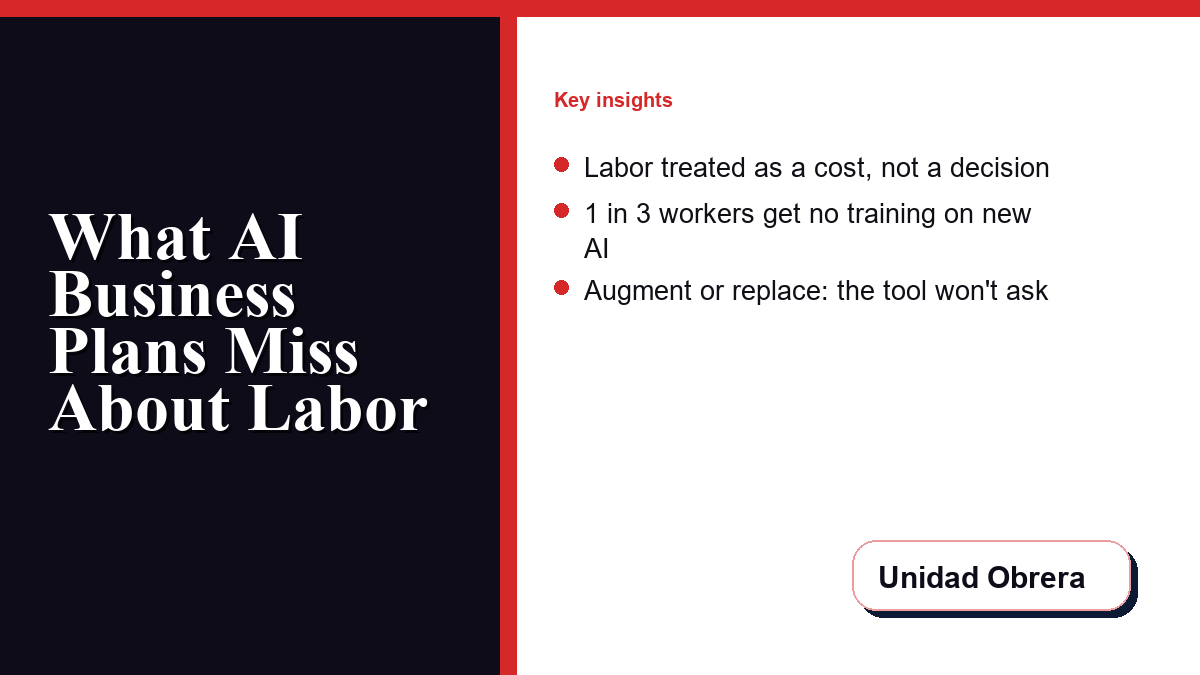
Most AI-generated financial projections model labor the same way they model rent or software subscriptions: a recurring expense to minimize, scaled against projected revenue. That framing isn’t wrong exactly, but it’s incomplete in a way that matters — it treats headcount, wage levels, benefits, and scheduling stability as cost-optimization variables rather than decisions with real consequences for retention, quality, and the actual people affected by them. A plan that only asks “how do we minimize this line item” has already answered a question about how the business will treat its workers, without the founder necessarily noticing they made that choice.
The Training Gap Reflected in the Underlying Data
More than one in three workers report their employer introduced new automation or AI tools in the past year, and most of those directly affected received no training on the change. That same pattern — automation decisions made without meaningfully involving the people affected by them — shows up structurally in how business planning tools are built: they’re optimized to help a founder plan the business, not to prompt a founder to think through what a given labor or automation decision means for the humans on the other side of it.
Augmentation vs. Automation Is a Framing Choice, Not Just a Technical One
Researchers distinguish between automation AI, which substitutes directly for a worker’s labor, and augmentation AI, which extends what an existing worker can do. A business plan generator doesn’t ask which of these a founder is actually building toward — it just optimizes the cost projection either way. That’s a meaningful gap: a plan that models “hire fewer people, at lower cost” and a plan that models “hire the same people, more capable” can produce similar-looking financial projections while representing genuinely different businesses to build.
Questions an AI Business Plan Tool Won’t Ask, But a Founder Should
- Is this labor line optimized for the lowest number, or the right number for the work? A plan that hits its margin target through understaffing is a plan with a retention and quality problem baked in from day one.
- Does the plan distinguish augmenting existing workers from replacing them? These are different businesses with different long-term outcomes, even when the year-one financials look similar.
- Who reviews the labor assumptions, not just the revenue assumptions? Revenue projections get scrutinized by investors by default; labor assumptions usually don’t get the same review, even though they shape the actual working conditions of real people.
None of this means AI planning tools are useless for the labor section of a business plan — it means the labor projections deserve the same scrutiny and explicit human judgment as the revenue ones, not less, precisely because they’re easier for a tool to gloss over as a simple cost input. Whatever tool a founder uses for this — Charigent’s own Business Builder feature included — the labor assumptions it generates are a starting draft for a human decision, not a finished answer to hand off without review.
The Bottom Line
A business plan is a set of decisions about how a company will operate, and decisions about how it will treat the people working there are among the most consequential ones in it — whether or not the planning tool that generated the projections treated that section with the weight it deserves.


0 Comments