
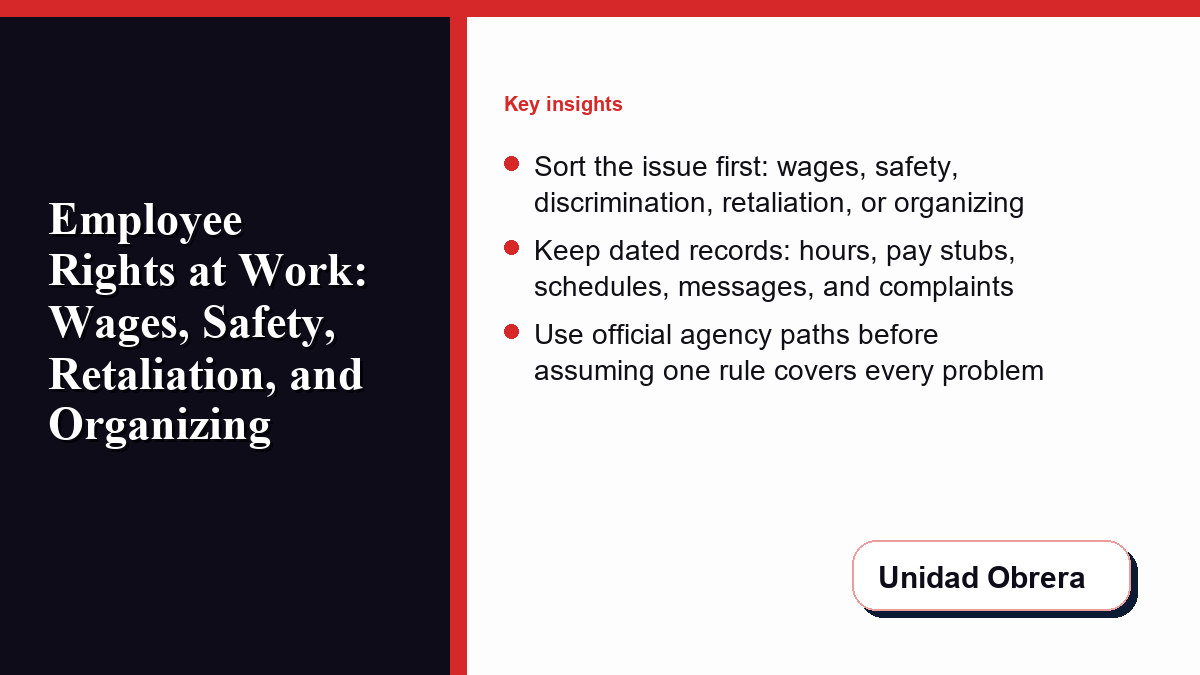
Workplace problems become harder to solve when every issue gets treated the same. A missing overtime payment, broken machine guard, discriminatory schedule change, or pressure not to talk with coworkers can point to different rights, agencies, and next steps.
This guide maps employee rights at work, then points readers to resources from the U.S. Department of Labor, OSHA, EEOC, NLRB, and USA.gov. It is educational information, not legal advice, and not a promise about an individual workplace situation.
What Employee Rights At Work Usually Cover
The phrase “employee rights at work” usually covers pay, hours, safety, discrimination, harassment, retaliation, leave, organizing, and documentation. The first practical question is not “Which law applies?” It is “What kind of workplace problem is this?”
The U.S. Department of Labor Wage and Hour Division points workers toward rights involving fair pay, overtime, leave, youth employment, farm work, and industry-specific resources. USA.gov’s labor laws hub separates wage laws, workplace laws, discrimination, safety, workers’ compensation, and termination topics.
Unidad Obrera’s mission is worker education and empowerment. This guide does not replace agencies, lawyers, unions, or worker centers. It helps a worker sort the concern, preserve the facts, and avoid losing time in the wrong lane.
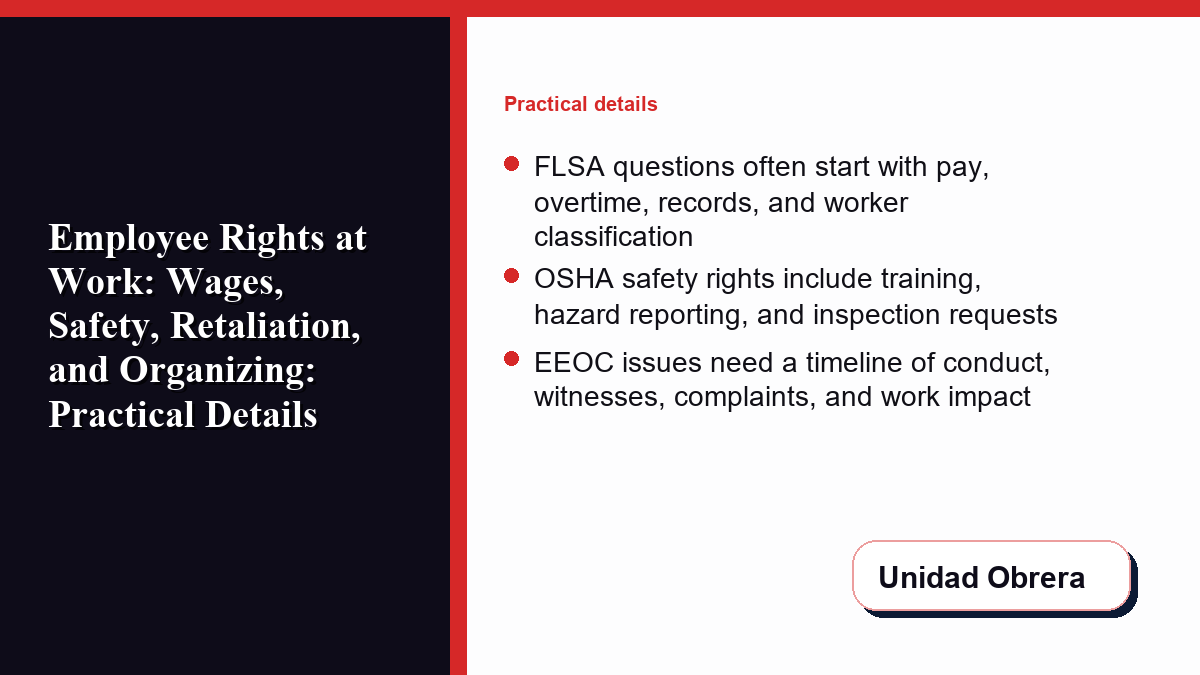
Pay Records, Minimum Wage, And Overtime Start With The FLSA
For many pay problems, the first federal reference point is the Fair Labor Standards Act, often shortened to FLSA. The Department of Labor’s summary of major laws explains that the FLSA sets federal standards for minimum wage, overtime pay, recordkeeping, and child labor for many private and public employees.
Workers should separate pay concerns into concrete questions. Were all hours recorded? Were overtime hours counted correctly? Is the worker being treated as an independent contractor when the work looks more like employment? Are unpaid training, waiting time, deductions, or travel time involved? These details matter because wage claims often turn on records, dates, job duties, and how the employer controlled the work.
A worker does not need a perfect legal theory before getting organized. A basic timeline, pay stubs, schedules, text messages, clock records, job descriptions, and written instructions can clarify the issue. If documents are missing, a written list of dates, hours, locations, supervisors, and what happened is still better than relying on memory later.
Safety Rights Include Training, Hazard Reporting, And Protection From Punishment
Workplace safety concerns belong in a different lane from wage disputes. OSHA’s worker rights page explains that federal law gives workers the right to a safe workplace, to speak up about safety concerns, to receive safety and health training in a language they understand, and to request an OSHA inspection. OSHA also describes specific rights around injury reporting, medical records, hazard test results, and required protective equipment.
Not every safety disagreement has the same urgency. A missing safety data sheet, repeated heat exposure, an unguarded machine, a fall hazard, or pressure to work after a serious injury all require different documentation. Start with what hazard exists, where it is, who was exposed, when the concern was raised, and how the employer responded.
OSHA says workers can report safety concerns without being punished or treated unfairly. If a condition appears to create an immediate serious danger, OSHA’s refusal-to-work guidance has specific limits. When possible, workers should contact OSHA or a qualified representative before assuming a refusal is protected.
Discrimination, Harassment, Equal Pay, And Accommodation Questions Need A Separate Review
Discrimination and harassment concerns usually require a different analysis from pay or safety complaints. The Equal Employment Opportunity Commission employee rights page identifies federal protections against harassment or unequal treatment based on protected categories including race, color, religion, sex, national origin, disability, age 40 or older, and genetic information. It also describes rights involving equal pay, reasonable accommodations, confidentiality, and retaliation protection.
For documentation, focus on specifics: what was said or done, who was involved, who witnessed it, whether the behavior repeated, how similar workers were treated, and whether a complaint or accommodation request was made in writing. Vague notes like “manager was unfair” are less useful than dated facts.
Federal, state, and local laws can overlap here. A worker may have an EEOC path, a state civil rights agency path, a union grievance path, an internal HR path, or more than one. Deadlines can matter, so serious concerns should be checked quickly through official sources or qualified counsel.
Retaliation Risk Starts When Protected Activity Triggers A Negative Response
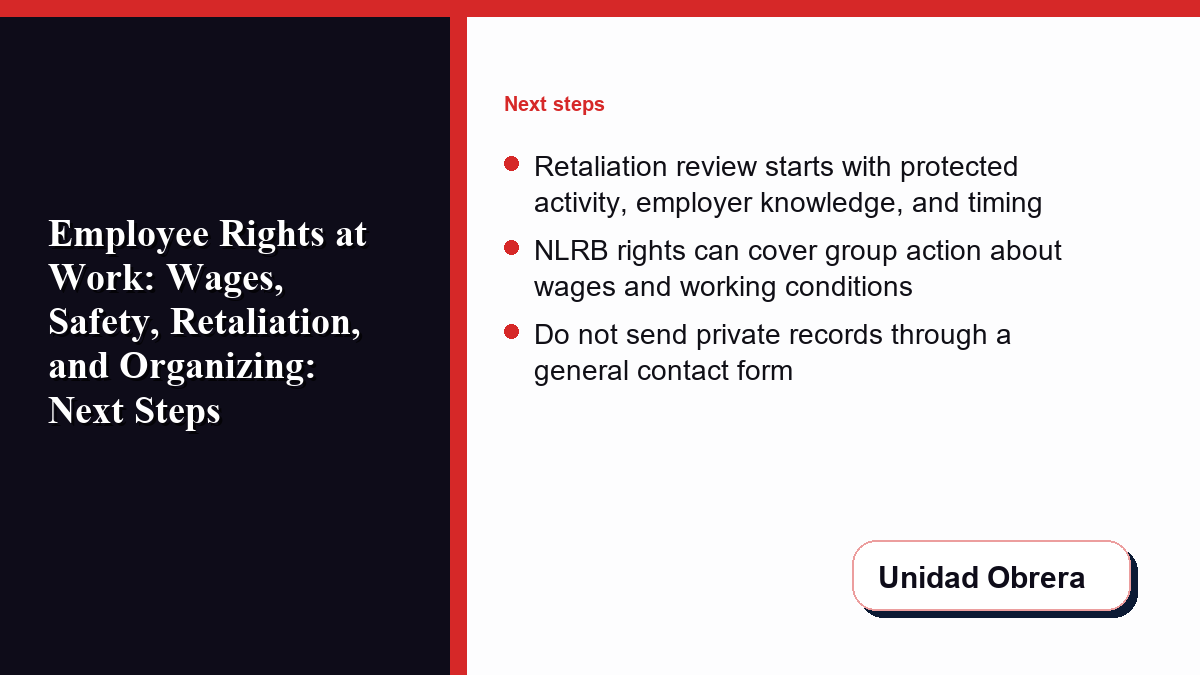
Retaliation can appear after many kinds of protected activity: raising a wage concern, reporting a safety hazard, opposing discrimination, participating in an investigation, discussing working conditions with coworkers, or asking about rights. If the employer responds with firing, demotion, reduced hours, threats, discipline, surveillance, or other negative treatment, the timeline matters.
The key is not to label every bad workplace event as retaliation. The stronger record answers three questions: what protected activity occurred, who knew about it, and what changed afterward. A dated sequence is often more useful than a long narrative. That kind of record gives an advocate, agency, or attorney something concrete to evaluate.
Unidad Obrera’s blog will build a separate workplace retaliation guide. Until then, workers should use official agency resources and avoid assuming one rule covers every retaliation concern.
Organizing And Discussing Work Conditions Are Rights Under The NLRA
Some workplace rights involve workers acting together. The National Labor Relations Board employee rights page explains that covered employees have rights to join together to improve wages and working conditions, with or without a union. The NLRB also describes rights around forming, joining, assisting, or refusing union activity.
Workers who are not represented by a union may still have rights to engage in protected concerted activity. In practical terms, that can include workers raising shared concerns about pay, schedules, safety, discipline, staffing, or other terms and conditions of employment.
This is separate from general workplace complaining. The question is whether the activity is connected to mutual aid or protection around workplace conditions. Document who participated, what condition was discussed, and how management responded.
How To Document A Workplace Concern Before Asking For Help
A clear record does not need to be dramatic. It needs to be consistent, dated, and tied to the actual workplace issue. Keep copies somewhere accessible outside work systems.
- Write a timeline with dates, times, locations, names, and events.
- Save pay stubs, schedules, time records, emails, texts, policies, warnings, and job descriptions.
- Separate facts from conclusions. Record what was said and done before assigning a legal label.
- Note witnesses and whether they saw the event directly or heard about it later.
- Preserve complaint records, including who received the complaint and how they responded.
- Do not alter documents, invent missing details, or secretly access files you are not allowed to access.
Where Workers Can Start Without Guessing
The best first resource depends on the problem. This table is a starting map, not a final legal answer.
| Workplace concern | Official starting point | What to prepare first |
|---|---|---|
| Unpaid wages, overtime, or pay records | DOL Wage and Hour Division worker rights | Pay stubs, schedules, hours, job duties, and employer messages |
| Unsafe equipment, hazards, injuries, or safety training | OSHA worker rights and protections | Hazard description, location, dates, injury records, and reports made |
| Discrimination, harassment, equal pay, or accommodations | EEOC employee rights | Incident timeline, protected category or request, witnesses, and complaint records |
| Organizing, union activity, or group action | NLRB employee rights | Who acted together, what condition was discussed, and management response |
| General uncertainty about which law or agency applies | USA.gov labor laws and worker protection | A short written description of the problem and the type of help needed |
If you need to suggest a correction, request a source update, or point us to a worker-rights topic that needs clearer coverage, use the contact page. Do not send private legal, medical, immigration, or employment records through a general contact form.
Final reminder: this article is educational information. It is not legal advice, it does not create an attorney-client relationship, and it cannot decide whether a specific worker has a claim. Use official agency resources, qualified legal help, a union representative, or a trusted worker organization when the facts are serious, time-sensitive, or disputed.
Frequently Asked Questions
What are the basic employee rights at work?
Basic workplace rights can include fair pay, overtime protections, safe working conditions, freedom from unlawful discrimination and harassment, protection against certain retaliation, and rights to discuss or act together about workplace conditions. The exact path depends on the issue and the worker’s situation.
Where should a worker start if several problems are happening at once?
Start by sorting the facts into categories: pay, safety, discrimination, retaliation, organizing, leave, or termination. Then prepare a dated timeline and use official agency resources to identify the right next step.
Can a worker be punished for reporting a safety concern?
OSHA says workers can speak up or report safety concerns without being punished or treated unfairly. Workers should document the concern, when it was raised, who knew about it, and what changed afterward.
What records are useful for a wage or overtime concern?
Useful records can include pay stubs, schedules, clock records, text messages, emails, job descriptions, written instructions, and a timeline of hours worked. Workers should keep records consistent and factual.
Is this guide legal advice?
No. This guide is educational information. Workers with urgent deadlines, immigration concerns, possible retaliation, serious safety hazards, or disputed facts should contact official agencies, qualified counsel, a union representative, or a trusted worker organization.

0 Comments